
Price rules
A pricing system that really thinks along
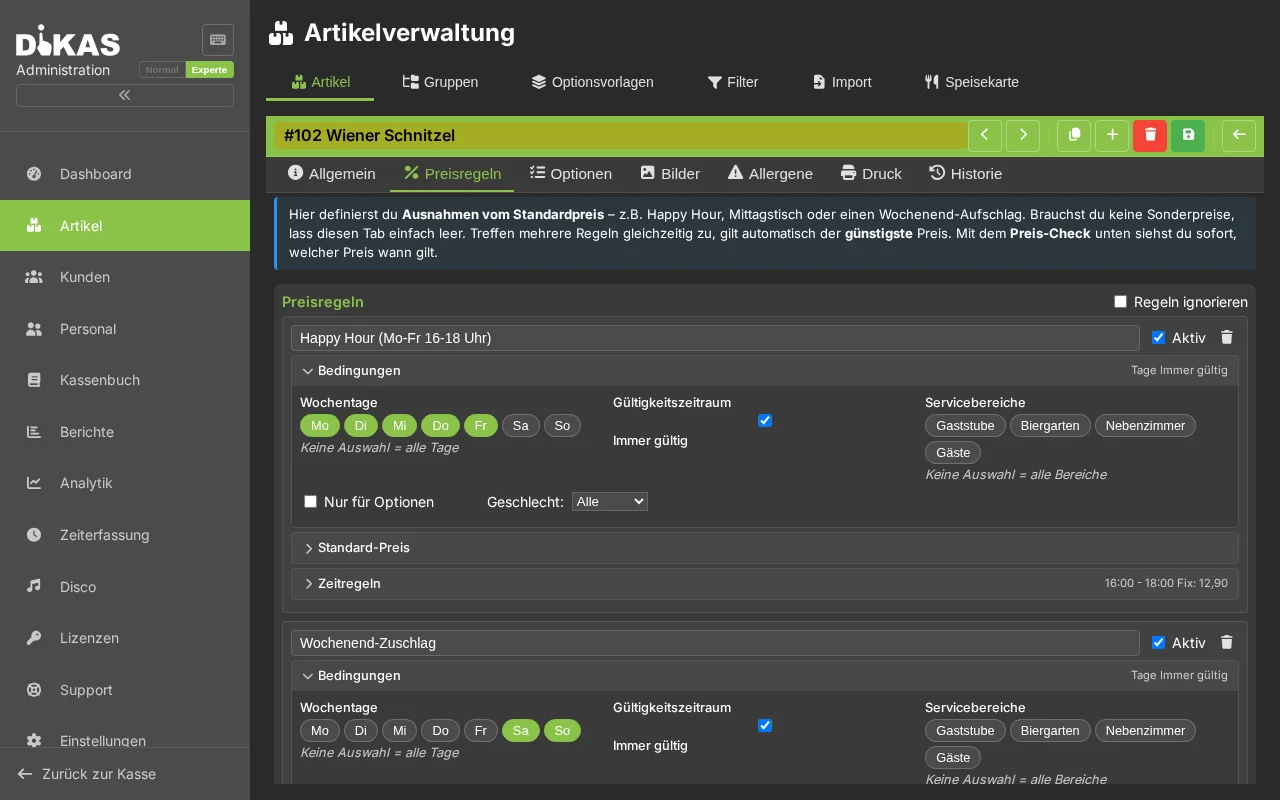
Happy hour, lunch deal, terrace and delivery prices, regular-customer discounts, time-limited promotions – in DiKAS you set this up once as a rule, and the right price appears automatically. Never again change prices by hand in the evening.
Example rule
Happy hour
Applies automatically – every week, with no extra step.
Conditions – freely combinable
Price adjustments – from percentage to fixed price
set it up – then it runs by itself
Manual steps in day-to-day business
Exceptions to the standard price
The right price – automatically at the right time
Happy hour, lunch deal, weekend surcharge, promo price until end of month: instead of changing prices by hand, you define rules that apply exactly when they should. If several rules apply at once, the cheapest one wins automatically – your guest always gets the lowest matching price.
Item or entire group
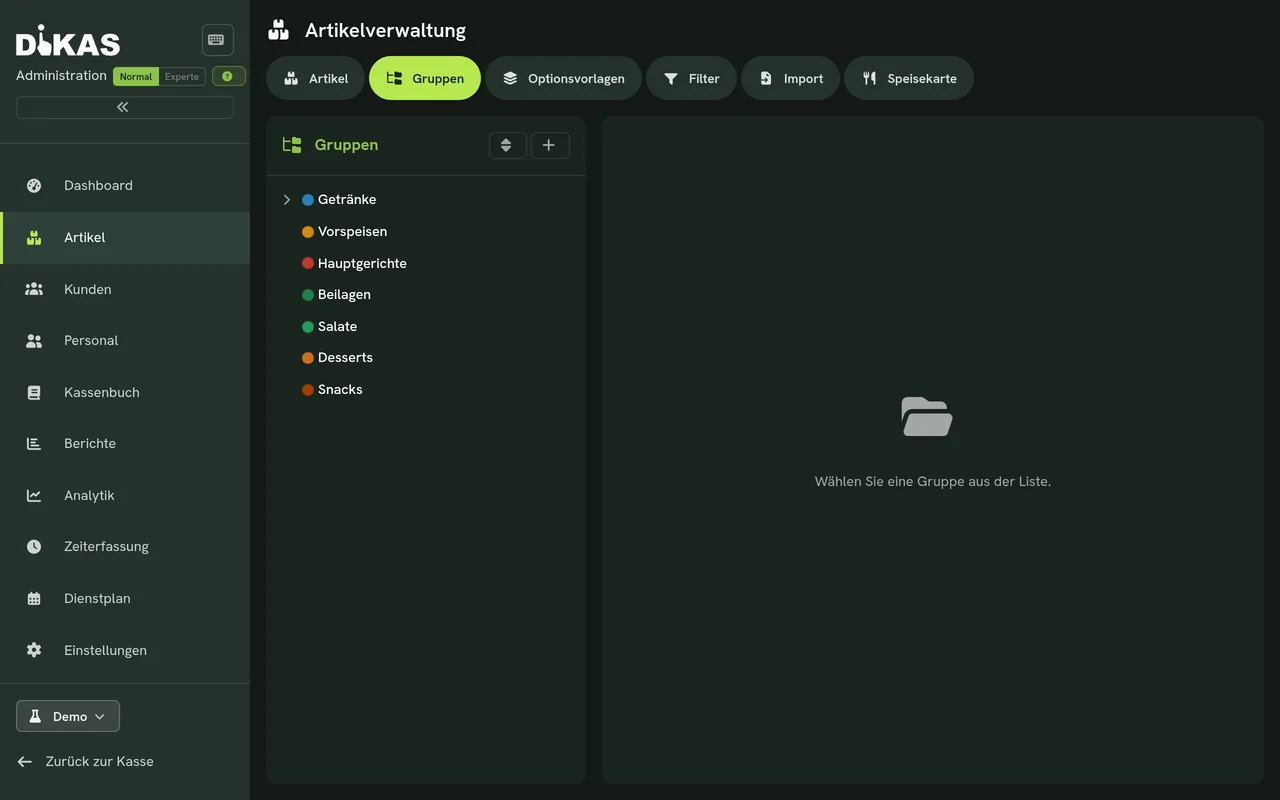
Once on the group – for all items
Set up a rule directly on the item group (e.g. “all cocktails –20 % during happy hour”) and it applies to every item in the group – including new ones. Or fine-tune it on the individual item. Individual items can also deliberately ignore rules.
Condition × adjustment
Freely combinable
Each rule consists of a condition (“when does it apply?”) and an adjustment (“what happens to the price?”). Both can be combined however you like.
When does the rule apply?
- Weekdays (Mon–Sun)
- Period with date from/to (time-limited promotions)
- Time windows (happy hour, lunch deal)
- Service areas (terrace, bar, event room …)
- Customer groups (regulars, staff, B2B)
- Workstations (individual tills)
- Dine-in / delivery / pickup separately
- Gender (e.g. ladies’ night)
- Applicable only to options
How does the price change?
- Sales % – percentage surcharge or discount (also negative)
- Sales fixed – fixed special price
- Sales +/- – add or subtract an amount
- Minimum price – never drop below a limit
- Round to 10 cents
- Extra-option discount controllable
Fair by design
When several rules apply, the cheapest wins automatically
If a regular picks up themselves at lunchtime, three rules apply at once. You don’t have to prioritise anything – DiKAS works through them all, and your guest never pays too much.
Examples from practice
Eight rules that make instant sense
Each consists of a condition (“if”) and a price adjustment (“then”). Set up once – it runs.
Happy hour
Fill the hour before the evening rush – without anyone moving signs around.
Lunch deal
Working people want it fast and cheap. A fixed price at lunch, back to normal in the evening.
Delivery surcharge
Packaging, fuel and the driver cost money. On delivery you add that on fairly – only there.
Pickup discount
Whoever picks up themselves saves you the driver. You give that back as a small bonus.
Terrace price
A sunny spot with table service may cost a touch more than the counter.
Regulars
Reward loyalty – permanently and automatically, without the counter having to think about it.
Ladies’ night
Selected drinks at a promo price on Friday night – the rule even knows the gender.
Opening week
Just opened? One week of promo pricing that ends by itself on the cut-off date.
Give it a try
Set the situation – and the price jumps
Three example rules, a cocktail at the standard price of €10.00. Choose day, time and place – if several rules apply, DiKAS automatically takes the cheapest.
Weekday
Time
Where
Cocktail · standard price €10.00
€7.00
This is just an example – you set up the real rules yourself. Try it in the live demo →
For your business
The same rules, four businesses
Price rules are in every DiKAS plan – here is how your industry puts them to use.
Prices that run themselves
Set up once, and it runs – day after day, automatically.